Buyer guide
Pickleball Paddle Specification Guide
A purchasing specification should describe the complete paddle, its permitted tolerances and the evidence needed for approval. Start with measured dimensions and construction details, then add artwork and packing requirements.
Last updated
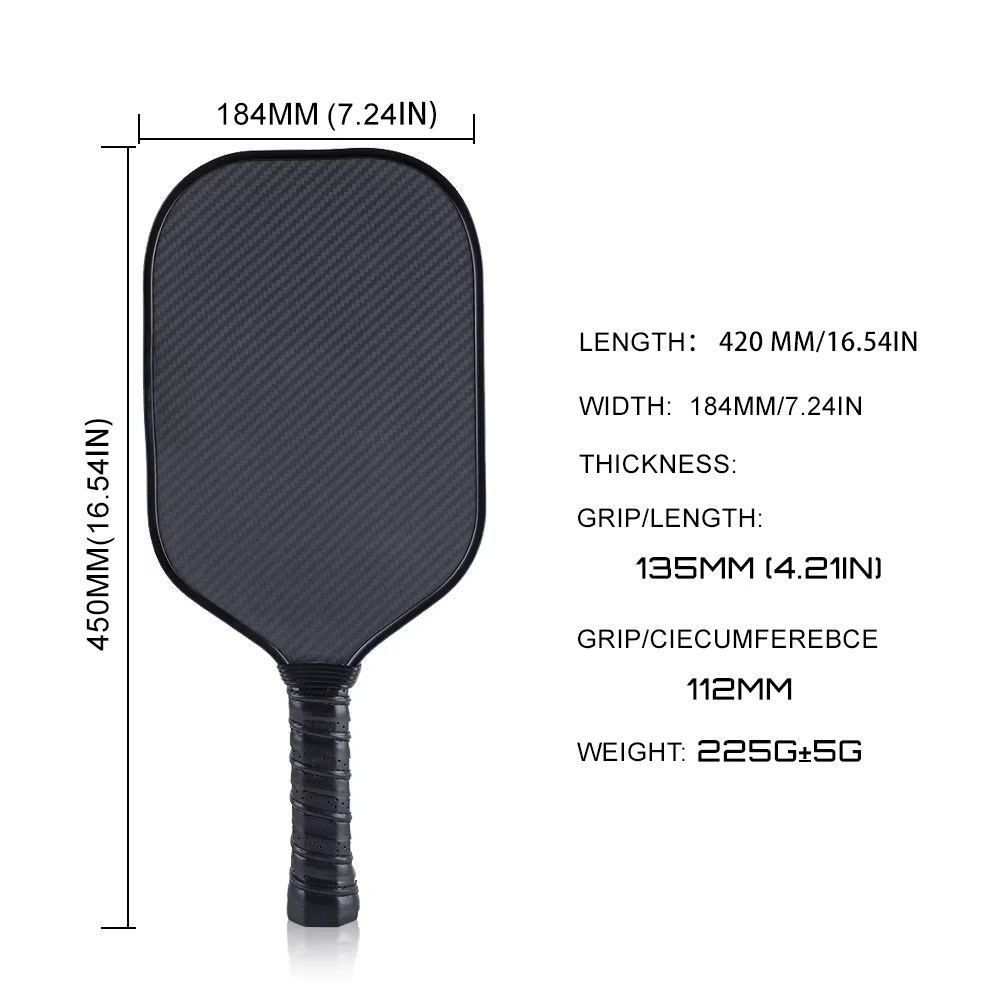
What a paddle specification should cover
A paddle specification is the document that lets two parties agree on exactly what will be made. It should be complete enough that a second factory could quote it, and precise enough that you can check a production paddle against it. In practice it has five parts: dimensions and mass, construction, surface and artwork, accessories and packing, and the evidence you want with the sample.
- Dimensions and mass: length, width, thickness, handle length, grip circumference, finished weight with tolerance, and balance point if you track it.
- Construction: face material and layers, core material and geometry, process (cold press, semi-hot press, hot press) and edge guard.
- Surface and artwork: texture or finish, print method, colours and artwork files for each design.
- Accessories and packing: grip, weight tape, cover, box, carton marks and barcodes. Our bulk order planning guide covers this side.
- Evidence: which measurements are recorded on the sample and repeated on production.
Pickleball paddle dimensions and the size rule
USA Pickleball sets two size limits: paddle length may not exceed 17 in (43.18 cm), and length plus width, including the edge guard and butt cap, may not exceed 24 in (60.96 cm). There is no limit on thickness and no limit on weight. Within those rules the outline is a design choice: standard shapes are about 15.5–16 in long and 7.5–8 in wide, and elongated shapes run around 16.3–16.5 in with a narrower face.
Measure the finished paddle, not the mold drawing: edge guard, paint and butt cap add length. The outlines in our catalog are listed below with their combined length and width.
| Mold | Size (mm) | L + W (in) | Handle / grip (mm) | Thickness | Models |
|---|---|---|---|---|---|
| FC001 | 417 × 184 | 23.66 | 140 / 110 | 16 mm | Spectra, Phantom Eye Standard, Solunaris Sol, Solunaris Luna and 3 more |
| FC005 | 417 × 192 | 23.98 | 145 / 110 | 16 mm | Halo X5 Red, Razor Blue, Razor Pink, Aero and 1 more |
| JS005 | 417 × 192 | 23.98 | 145 / 110 | 16 mm | Vactor, Surge Hexcore 5S, Lava Claw, Blush Butterfly and 5 more |
| TY18 | 415 × 187.5 | 23.72 | 138 / 112 | 16 mm | Phantom Eye Irregular |
| FC002 | 414 × 192 | 23.86 | 140 / 110 | 16 mm | Stellar Blue, Aquora, Aerrow |
| GH8001 | 403.5 × 195 | 23.56 | 133 / 112 | 13 mm | Horizon S1 Purple, Galaxy, Volora, Heartbeat S1 Pink and 1 more |
| JT-1 | 398 × 198 | 23.46 | 127 / 112 | 14 mm | Arcus S1 Red, Vokar Red, Rift, Vortex and 4 more |
| FC007 | 343 × 180 | 20.59 | 126 / 105 | 14 mm | WonderDream & Space Adventure Junior, Animal Heroes Junior |
| JT004 | 254.5 × 128 | 15.06 | – | 14 mm | Mood Pop Mini |
A longer handle (140–145 mm in our range) leaves room for a two-handed backhand; a shorter handle (126–133 mm) gives more of the length to the face. Grip circumference in our range runs from 105 mm on junior paddles to 112 mm.
14 mm vs 16 mm pickleball paddles
Thickness is the most-asked specification question. Both are common, and the difference is real but smaller than marketing suggests.
| 14 mm (also 13 mm) | 16 mm | |
|---|---|---|
| Typical description | Quicker off the face, more pop | Softer, more controlled, more forgiving |
| Bending stiffness | Lower with the same faces | Higher with the same faces |
| Weight | Slightly less core material | Slightly more core material |
| In our range | JT-1 carbon (14 mm), GH8001 fiberglass (13 mm), FC006 foam builds, junior and mini paddles | FC001, FC002, FC005 and JS005 builds, including all hot-pressed models |
Thickness interacts with everything else in the sandwich. A thin, stiff face over a dense 14 mm foam can be more controlled than a soft 16 mm honeycomb. Decide which feel you want, then compare a 14 mm and a 16 mm sample with the same face and outline. There is no thickness rule, so 12 mm and 20 mm paddles exist too; 13–16 mm covers almost all mainstream play.
Weight, swing weight, twist weight and balance
Static weight is only the start. Two paddles of the same weight can swing very differently because of where the mass sits.
- Weight. Most adult paddles weigh about 7.3–8.5 oz (roughly 205–240 g). Lightweight is usually under 7.5 oz, midweight 7.5–8.2 oz and heavy above that. Our adult listings run from 215 ± 5 g to 230 ± 5 g, and junior paddles are 160 ± 5 g.
- Balance point. The distance from the butt end to the point where the paddle balances, in millimetres. A higher balance point feels head-heavy.
- Swing weight. Resistance to swinging, measured as a moment of inertia about an axis near the grip on a swing-weight machine. It rises quickly with mass added near the tip.
- Twist weight. Resistance to twisting on off-center hits, measured about the paddle's long axis. Mass at the edges raises it and widens the effective sweet spot.
If you put swing weight, twist weight or balance in a specification, also state the instrument, the axis and the unit. Numbers from different machines are not comparable. Our engineering workbench lets you explore how mass and geometry interact.
Adding weight: lead tape placement
Our performance models ship with 12 lead tape strips so players or retailers can tune the paddle. Where the tape goes matters more than how much is added.
| Placement | Main effect | Typical use |
|---|---|---|
| Top of the head (12 o'clock) | Raises swing weight and moves balance toward the head | More drive and put-away power, slower hands |
| Sides (3 and 9 o'clock) | Raises twist weight; small swing-weight change | More stability on off-center hits |
| Lower sides (4 and 8 o'clock) | Some stability with less swing-weight gain | A compromise for quick hands at the kitchen |
| Handle or under the butt cap | Moves balance toward the hand; little swing-weight change | Heavier feel that still swings quickly |
Start with 1–2 g and test; a few grams change the feel noticeably. Edge guard tape also adds a little weight. If you sell a pre-weighted version, specify the tape position and mass in the specification so every paddle matches.
Construction and surface
Name the face material and number of layers (for example, three-layer T300 carbon), the core (see the core guide), the process and the edge guard. For the surface, specify texture and print method rather than a general word such as "grit". USA Pickleball tests finished paddles for surface roughness, ball rebound (PBCoR, introduced in late 2024) and deflection. The thresholds are set in its Equipment Standards Manual and have been revised more than once, so check the current revision when you specify a textured face.
Sample approval checklist
- Measure length, width, thickness, handle and grip and compare them with the specification.
- Weigh the finished paddle and record balance point if you track it.
- Check artwork, colours, edge guard and grip against the approved files.
- Confirm the face, core and process on the build sheet.
- Agree which of these measurements the factory repeats on production and how results are reported.
- Keep one signed-off sample as the physical reference for sample approval and bulk ordering.
Frequently asked questions
What is the difference between 14 mm and 16 mm pickleball paddles?
With similar materials, 16 mm paddles tend to feel softer and more controlled, and 14 mm paddles quicker with more pop. Face, core and outline also matter, so compare finished samples.
What is the maximum size of a pickleball paddle?
Under USA Pickleball rules, length may not exceed 17 in, and length plus width, including edge guard and butt cap, may not exceed 24 in. Thickness and weight are not limited.
How much should a pickleball paddle weigh?
Most adult paddles weigh about 7.3–8.5 oz (205–240 g). Lighter paddles are quicker; heavier paddles are more stable and powerful.
Where should I put weight on my pickleball paddle?
At the top to add power and swing weight, at 3 and 9 o'clock to add stability, and in the handle to add mass without making the paddle swing heavier. Add 1–2 g at a time.
What is swing weight on a pickleball paddle?
It is the paddle's resistance to being swung, measured as a moment of inertia about an axis near the grip. Record the instrument and unit, because readings from different machines differ.
What is twist weight?
Resistance to twisting on off-center hits. Higher twist weight feels more stable and forgiving.